Great Horned Owl Release Scheduled Feb. 10, 2026 At The Roanoke Star
|
|
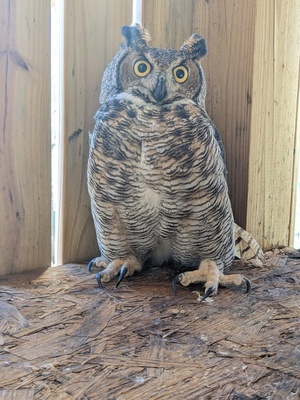
Roanoke, VA (Feb. 6, 2026) - This Great Horned Owl, patient 2025-1665, was admitted on August 31, 2025 from the Mill Mountain Estates area of Roanoke City. Now, after a lengthy 6 month rehabilitation, we're elated to announce that this patient will be going back home and taking to the skies once more!
Southwest Virginia Wildlife Center of Roanoke will be releasing a Great Horned Owl on February 10, 2026 at the Roanoke Star overlook at 5 p.m. Public is encouraged to attend!
Background: A concerned citizen found this beautiful owl on the ground with a damaged left wing and was unable to fly. At intake, we determined that it was an adult, weighed 1.55kg, presented with damage to both wings, and had clinically significant chest swelling. Radiographs showed no fractures and the ocular exam was unremarkable. Given this data, our best guess is that it was likely hit by a car. Our team immediately went to work administering fluids to help with dehydration and began pain management along with anti-inflammatory medication. After lots of cage rest and physical therapy, this patient graduated to an outside enclosure where it began learning to fly again. After such a long stay it is common for raptors to experience pectoral muscle atrophy which can require several months of flight strengthening prior to release.
Owls belong to the order Strigiformes and are divided into two main families: Strigidae (true owls), which have round faces and make up the vast majority of species, and Tytonidae (Barn Owls), known for their distinct heart-shaped faces. Great Horned Owls (Bubo virginianus) are the largest owls native to Virginia weighing around 3 pounds. They have a mottled gray-brown body, a reddish-brown facial disk, and large yellow eyes. These owls are highly adaptable to various habitats, including forests, swamps, deserts, and suburban neighborhoods. These apex predators can carry up to 3 times their own body weight and have a very diverse diet. They primarily feed on mammals such as rodents, groundhogs, rabbits, squirrels, hares, and are one of the only predators in our area known to eat skunks. They've also been known to eat snakes, frogs, crabs, American Crows, ducks, loons, herons, and even other raptors like Red-tailed Hawks and Osprey! | | | | | |
|